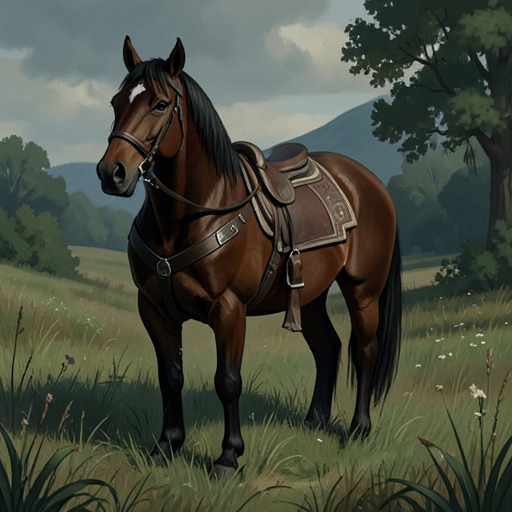
Aslan's encounter with Aravis and Bree
The Horse and His BoyAslan's encounter with Aravis and Bree at the Hermit's Enclosure is a scene of recognition and correction: the travelers see the lion who has followed their journey, Bree is forced to confront the limits of his understanding, and Aravis learns that Aslan's earlier attack on her was connected to the punishment she had caused another person to suffer. The meeting makes their separate journeys newly legible without giving either traveler access to another's story.
Setting and Approach
Bree has his back to the green wall as he speaks to Aravis and Hwin. His confident account of Aslan is interrupted when the two mares see an enormous lion appear outside the wall, balance on its top, and leap silently into the enclosure. They cannot warn Bree; he remains unaware of the lion approaching behind him while he continues to explain what he thinks the name Lion means.
Bree argues that people in Tashbaan use the title figuratively: Aslan may be as powerful or fierce as a lion, he suggests, but cannot literally be one. He treats the idea as absurd and disrespectful, reasoning that a lion would have the same features and status as any other Beast. The scene places his abstract argument beside the lion's actual presence. Aslan does not answer at a distance: he is already inside the enclosure, close enough to touch Bree before Bree knows he is there.
Recognition and Response
As Bree names a lion's paws, tail, and whiskers, one of Aslan's whiskers touches his ear. Bree bolts to the opposite side of the enclosure, where the high wall prevents him from escaping. Aravis and Hwin retreat as well, and the group falls silent. The encounter overturns Bree's confident explanation through immediate physical evidence: Aslan is not merely a comparison for strength or a figure in stories told in Tashbaan.
Hwin is the first to approach. Though shaking, she crosses to Aslan and tells him that she would rather be eaten by him than fed by anyone else. Aslan calls her his daughter, kisses her nose, and assures her that joy will be hers. Her response contrasts with Bree's flight: fear remains, but it does not prevent her from drawing near. Aslan then calls Bree a proud and frightened horse and urges him to come closer, touch him, and smell him. He identifies himself as a true Beast and invites Bree to verify what he had just dismissed.
Bree admits that he may be a fool. Aslan replies that it is fortunate to recognize this while still young, whether the traveler is a Horse or a Human. The exchange makes Bree's mistake more than an error about what Aslan is: his certainty had kept him from recognizing what was before him. Aslan's instruction, "Do not dare not to dare," asks Bree to approach despite that fear. He then invites Aravis forward too, explaining that his paws are velveted and that she will not be torn this time.
Aravis and the Earlier Wound
Aravis asks what Aslan means by "this time." He tells her that he was the only lion she met during her journey and asks whether she knows why he tore her. When she says she does not, Aslan connects her wounds to the punishment inflicted on her stepmother's enslaved person after Aravis drugged that person into sleep. He explains the correspondence as exact: her scratches matched the stripes laid on the enslaved person's back, so that Aravis would know what the other person had felt.
The disclosure joins two episodes that Aravis had not understood as related. Her earlier action had harmed a person kept in slavery; Aslan's intervention made the consequences personal to her rather than leaving that harm as an abstraction. The scene states the connection without claiming that Aravis knows every consequence of what she did. Indeed, she immediately asks whether the enslaved person will suffer any more because of her action.
Aslan refuses to answer for the other person's story. He tells Aravis that he is telling her own story, and that no one is told anyone else's. The boundary does not erase her concern; it limits what she is entitled to know. The principle also shapes the meeting itself: Aslan gives Bree an answer about Bree's fear and understanding, and gives Aravis an explanation about Aravis's past, rather than turning their encounter into a complete account of every life affected by their actions.
Departure and Significance
After answering Aravis, Aslan shifts to a lighter tone, tells the travelers to be merry, and says they will meet again soon. He adds that another visitor will come before then, leaps to the top of the wall, and disappears from their sight. The encounter ends without the group discussing him together: each moves to a different part of the quiet grass and paces alone, thinking. Their separate silence echoes Aslan's insistence that each person must receive and consider their own story.
The scene brings together recognition, fear, accountability, and limits of knowledge. Bree's attempt to reduce Aslan to a metaphor gives way to direct encounter; Hwin approaches despite trembling; and Aravis learns the personal meaning of a wound she had not understood. Aslan's authority in the scene is expressed both through his power to appear and through the particularity of what he tells each traveler. His answers do not make their experiences interchangeable: they return Bree to the challenge of approaching, and Aravis to the consequences of her own action.